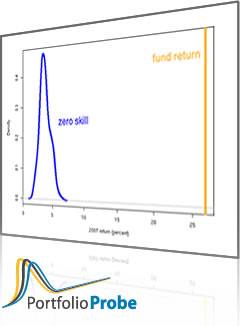
How to visualize luck when looking for skill. Quantitative Finance just published the paper Dicing with the market: randomized procedures for evaluation of mutual funds by Francesco Lisi. Here is the working paper version. This paper explains one way of using random portfolios to do performance measurement of investment funds. It includes performance measures on … Continue reading
Portfolio Probing
Dicing with the market
Posted in Performance, Random portfolios
Tagged investment performance measurement, luck versus skill
1 Comment
The Super Bowl Indicator
The Super Bowl will take place on Sunday. This is the final game for American Football (if you have to ask, then: “No, not real football”). Not only is it a highlight in sports, it is also a financial highlight as it determines the fate of the US stock market for the year. You can … Continue reading
The mean reversion of Groundhog Day
February 2nd is Groundhog Day. If Punxsutawney Phil sees his shadow, then he goes back into his burrow and hibernates for six more weeks. Otherwise he predicts an early spring. It is really a mean reversion idea — current good weather means bad weather later, and vice versa. The other Groundhog Day Most people outside … Continue reading
Beware Mr Market
Thinking of the market as having a personality can be fun and educational. But it has a dark side as well. Benjamin Graham The idea of Mr Market was created by Benjamin Graham as a way of conveying the wisdom of fundamental analysis. Graham’s intentions were to make people act more rationally. Ironically, thinking of … Continue reading
Financial instability
Instability in the economy seems to be the zeitgeist of the week. Counter-intuitives Science Daily has a story on a mathematical model of extinction. Apparently a key finding is that the most effective interventions in the model when a species declines are counter-intuitive. An analogy: brakes don’t stop you when you are driving in snow, … Continue reading
A field guide to market participants
Fundamental Hawk (perusii balancesheetus) Very discriminating in diet. Often seen scratching in the undergrowth. Subsists on irrationality, short-lived variety only. Macro Harrier (exsanguinus economicus) Flies very high. Reports of bombardier behavior (unsubstantiated). Common Quant (quantus quantus) Flies backwards looking in mirror. Seldom seen without a factor model. High Frequency Quant (quantus nanosecondii) Flies backwards really, … Continue reading
Review of “R Graphs Cookbook” by Hrishi Mittal
Executive summary: Extremely useful for new users, informative to even quite seasoned users. Refereeing Once upon a time a publisher asked if I would referee a book (unspecified) about R. In an instance that can only be described as psychotic I said yes. That bit of insanity turned out to be a good thing. I … Continue reading
Paying interest and the number e
Suppose I borrow a dollar from you and I’ll pay you 100% interest at the end of the year. How much money will you have then? $1 * (1 + 1) = $2 What happens if instead the interest is calculated as 50% twice in the year? $1 * (1.5 * 1.5) = $2.25 After … Continue reading
In the blogosphere this week: sunshine and Vegas
Gambling Falkenblog has a post called: Why Do People Gamble? This includes the often-stated “problem” that the same people both: pay for insurance pay to gamble Maybe I’m being thick, but I don’t see any problem. I see both these activities as buying positive skewness: paying a little now for an uncertain but big positive … Continue reading
Normal market accidents
We think of accidents as abnormal events, but there is “normal accident” theory. We don’t think of accidents happening in markets, but they do. That’s why it’s called a market crash. For normal accidents to come into play, two conditions need to hold: the system is complex the system is tightly coupled Certainly the financial … Continue reading
Posted in R language, Risk
Tagged contagion, market crash, normal accident, too big to fail
1 Comment