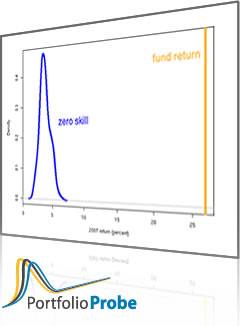
David Rowe has a short piece called Regulators Double Down. He argues that risk regulations should be simple at the expense of consistency, rather than complex at the expense of knowing the consequences. I wish to remain a cool remove away from discussions of regulation. However, I very much agree with David’s argument. I see … Continue reading
Portfolio Probing
Feeding a greedy algorithm
The idea of a greedy algorithm (for optimization) is that you do as best you can locally and you don’t worry about the big picture. For some problems a greedy algorithm is guaranteed to get you to the global optimum. In other cases, no. An intuitive example Suppose you are walking and you want to … Continue reading
Some quibbles about “The R Book” by Michael Crawley
A friend recently bought The R Book and I said I would tell him of problems that I’ve noticed with it. You can eavesdrop. Page 4 The word “library” is used instead of “package”. This (common) error substantially raises the blood pressure of some people — probably to an unwarranted extent. An R package is … Continue reading
Freeloading turnstile jumpers
What would happen if I jumped the turnstile at my local tube station? Well okay, duck under in my case. Best case: people glare at me like I’m scum. Worst case: I’m thrown back out and have to pay a fine (and there are even more glares). It would be perhaps three to five dollars … Continue reading
Bear hunting
When were there bear and bull markets in US stocks since 1950? Smoothing While we’d really like to estimate the expected return at each point in time, finding bear markets is ambitious enough. The plan starts by smoothing the daily returns through time, as in Figure 1. Figure 1: Smoothed returns with a 4 year … Continue reading
The good side of inside trading
All About Alpha has a post called Insider traders: rogues or whistleblowers? It is a pleasantly disturbing look at insider trading in that it challenges the reflex reaction that inside trading is all bad. In particular the final paragraph discusses an interesting inconsistency. One issue that is highlighted is that it is harder for negative … Continue reading
Joy of Stats coming soon
The Joy of Stats really is a joy. It will be shown on BBC4, apparently scheduled for December 7. (That date comes from Hans Rosling on twitter, I haven’t found scheduling evidence at the BBC.) I saw its debut at the Royal Statistical Society on World Statistics Day. Here is a five minute excerpt: You … Continue reading
Posted in R language, Statistics
8 Comments
Yet another inferno
Many from the R world will know The R Inferno. Abstract: If you are using R and you think you’re in hell, this is a map for you. A newly minted inferno is The 9 circles of scientific hell. Most amusing to me is Circle 4: p-value fishing, the punishment of which is brilliant. As … Continue reading
Posted in R language, Statistics
Leave a comment
Were stock returns really better in 2007 than 2008?
We know that the S&P 500 was up a little in 2007 and down a lot in 2008. So on the surface the question seems really stupid. But randomness played a part. Let’s have a go at deciding how much of a part. Figure 1: Comparison of 2007 and 2008 for the S&P 500. Statistical … Continue reading
Review of “Obliquity” by John Kay and “Drive” by Daniel Pink
How could a book about indirectly solving problems and one about human motivation be saying the same thing? Obliquity Chapter 1 (and more) is about happiness. We’ve been here before — with a review of The Happiness Equation. Unlike The Happiness Equation, this book gives us some real insight into happiness. Kay divides happiness into … Continue reading