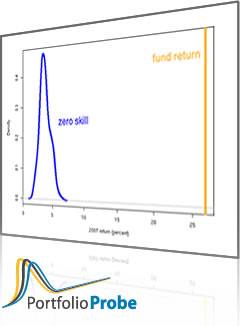
Guiding a ship, it takes more than your skill Spark David Rowe’s Risk column this month is about data leverage. The idea is that you are leveraging your data if you are using it to answer questions that are too demanding of information. The piece reminded me of a talk that Dave gave a few … Continue reading
Portfolio Probing
US market portrait 2012 week 16
US large cap market returns. Fine print The data are from Yahoo Almost all of the S&P 500 stocks are used The initial post was “Replacing market indices” The R code is in marketportrait_funs.R Subscribe to the Portfolio Probe blog by Email
Posted in Market portrait
Leave a comment
Three things factor models do
Factor models are heavily used in finance to create variance matrices. Here’s why. Factor models: Provide non-degenerate estimates Save space Quantify sources of risk Non-degenerate estimates First off, what does this mean? The technical term is that you want your estimate of the variance matrix to be positive definite. In practical terms what that means … Continue reading
Posted in Quant finance
Tagged factor model, Ledoit-Wolf shrinkage, statistical factor model
3 Comments
US market portrait 2012 week 10
US large cap market returns. Fine print The data are from Yahoo Almost all of the S&P 500 stocks are used The initial post was “Replacing market indices” The R code is in marketportrait_funs.R Subscribe to the Portfolio Probe blog by Email
Posted in Market portrait
Leave a comment
Betas of the low vol cohorts
How did the constraints affect portfolio betas, and how did the betas change over time? Previously “Low (and high) volatility strategy effects” created 6 sets of random portfolios — the so-called low vol cohorts — as of 2007 and showed their performance up to about a month ago. “Rebalancing the low vol cohorts” looked at … Continue reading
Posted in Quant finance, R language, Random portfolios
Tagged beta in finance, low volatility investing
1 Comment
Replacing market indices
If equity markets suddenly sprang into existence now, would we create market indices? I’m doubtful. Why an index? The Dow Jones Industrial Average was born in 1896. This was when computers were humans with adding machines (but they did do parallel processing). At that point boiling “the market” down to a single number had value. … Continue reading
Maximum weight of the low vol cohorts
Maximum weight was constrained to 4% at the start of 2007, how does that grow when unhindered? Previously “Low (and high) volatility strategy effects” created 6 sets of random portfolios as of 2007 and showed their performance up to about a month ago. “Rebalancing the low vol cohorts” looked at how much turnover was required … Continue reading
Posted in Quant finance, Random portfolios
1 Comment
Rebalancing the low vol cohorts
How much turnover is required to get portfolios back to their constraints? Previously “Low (and high) volatility strategy effects” created 6 sets of random portfolios as of 2007 and showed their performance up to about a month ago. This post explores how much turnover it takes to get the portfolios to obey their constraints at … Continue reading
Posted in Portfolio Probe, Quant finance, Random portfolios
Tagged rebalancing, turnover
Leave a comment
Beta is not volatility
The missing link between beta and volatility is correlation. Previously “4 and a half myths about beta in finance” attempted to dislodge several myths about beta, including that beta is about volatility. “Low (and high) volatility strategy effects” showed a plot of beta versus volatility for stocks in the S&P 500 for estimates from 2006. … Continue reading