
Review of “Models. Behaving. Badly.” by Emanuel Derman
January 30, 2012
Why confusing illusion with reality can lead to disaster, on Wall Street and in life.
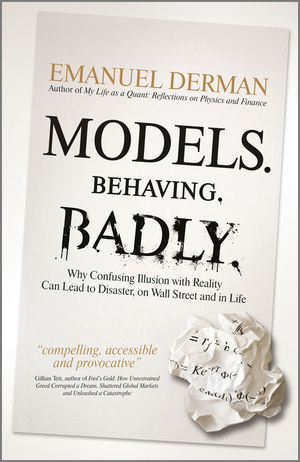 Note that the cover is more clever than you might at first notice. Ceci n’est pas une pipe.
You might also have a guess at the reason for the punctuation in the title.
Executive summary
Non-quants should embrace models more, quants should distance themselves more.
Audience
This is not just another quant book written by a quant nerd. It is suitable for everyone, but — as stated above — the message is different depending on where you’re starting.
The real topic is approached obliquely. The book is telling us that things that we want to make simple are actually complicated. Finesse is in order. When you have the urge to skim a section, that is probably a sign that you should read that part most carefully — and wonder why it’s there.
Models are mandatory
There is a lot of noise about how models have caused economic turmoil. The key point of the book is that we have no choice but to use models. Given that our brain creates a model for what we see, it shouldn’t be surprising that we have to use models for less fundamental endeavors.
The question is not “Do I use a model?” but rather “How aware am I of the model and its limitations?”.
Resist addiction
Once we know what model we are using, we need to avoid abusing it by thinking it is real.
All models are wrong, some models are useful.
— George Box
We should believe that the model is both right and wrong.
Efficient Market Model
The book suggests — rightly, I think — that the Efficient Market Hypothesis should be called the Efficient Market Model.
since it’s a model of a hypothetical world rather than a correct hypothesis about the one we inhabit.
CAPM
It is a sign of the political power of models that commercial websites publish the value of beta, a parameter in a model that doesn’t work that well, but not the more fundamental and model-neutral volatility statistic sigma.
Favorite sentence
… technical analysis, a combination of rational and magical thinking that involves spotting the repetition of patterns in the trajectory of stock prices.
In closing
Models are only models, not the thing in itself. Models are better regarded as a collection of parallel thought universes to explore.
Epilogue
Everything I’ve ever told you has been a lie, including that.
the devil in “Bedazzled”

[…] accepted explanation of it. GARCH (Generalized AutoRegressive Conditional Heteroskedasticity) models volatility clustering. It does not explain it. Figure 1 is an example of a garch model of […]
[…] Points beyond the whiskers are sometimes referred to as “outliers”. That is not particularly good nomenclature. For there to be an outlier, there really needs to be a model. […]
[…] been a concerted and sustained effort to turn it into CAPT as in Truth — a prime example of Models Behaving Badly. The paper is an example of using the model in quite a good […]