
Clever versus simple risk management
December 20, 2010
David Rowe has a short piece called Regulators Double Down. He argues that risk regulations should be simple at the expense of consistency, rather than complex at the expense of knowing the consequences.
I wish to remain a cool remove away from discussions of regulation. However, I very much agree with David’s argument. I see two key reasons that the statistics of financial risk is extremely hard:
- interest in tail events rather than central events
- finance is dynamic
Tail events
Asking how bad a portfolio might do in the future is like asking how bad a river might flood. Getting a good estimate of the heights of floods is hard. You can have close to a perfect idea of the average level of the river — you have lots of observations for that.
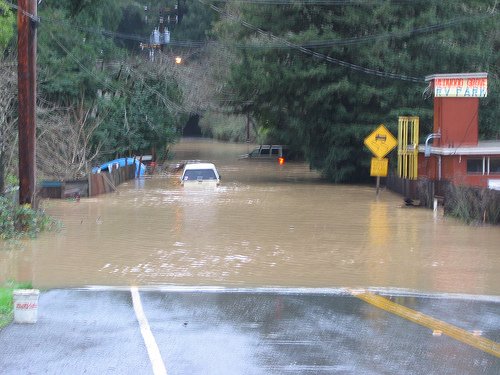
In a sense you don’t have any observations for the most extreme floods. You have to model the distribution of floods and then extrapolate beyond what you’ve ever seen.
Floods wouldn’t be news if we could estimate them well.
In finance we are trying to determine the level of “floods” for a river that continuously fluctuates wildly.
Dynamics
Estimating flood levels for a pristine river is hard. But it gets harder.
It is well known that development (building houses, logging, dredging, …) often increases the severity of floods. We now have a hard problem embedded in a changing system. The changes imply that our past observations have changed their meaning.
Financial markets are always dynamic. We know that there are the analogies of logging and dredging going on, but we don’t see them and we don’t know their effect.
Risk models
I’m not saying that complex risk models should be completely abandoned. I think many of them have value. The problem is too much faith in any of them — simple or complex.
Which is harder to stay coolly removed from?:
- a sophisticated model you’ve spent lots of time building
- a simple model you automatically think of as stupid.
Simple and stupid can be better.
Epilogue
One cool remove-from the things that hurt me
One cool remove-from the sea and the city
from One Cool Remove by Greg Brown
Photo by Jessica Merz via everystockphoto.com
